The customer
Katholiek Onderwijs Vlaanderen (KOV) is the largest educational network in Flanders, Belgium, including over 2,200 schools that serve around 935,000 students. As a membership organization, it represents a wide range of educational institutions, from kindergartens to universities, including special needs and vocational schools. The organization provides vital support to its member schools, offering legal, administrative, and management advice, while promoting a high-quality education rooted in Catholic values.
The context
KOV supports its member schools with various administrative tasks as well. One of the tasks it helping with the subsidies for buildings. For one school it can take up to 15 years until subsidies get approved and construction starts. A good management and storage of the documents is then essential. For this KOV made a system to track the administration part of buildings and the subsidies. To maintain this system, there is a lot of manual labor, eg. going manually through email attachments, extracting and entering data from documents into the building management platform (David). Managing email content means that employees spend a significant amount of their time simply reading and sorting incoming messages. In addition to this, they have to navigate through long SharePoint document libraries, searching for the right folder to store each document.
This manual process is not only slow but also creates a heavy workload on the team working on the tasks. To streamline operations, KOV partnered with Sparkle and Microsoft to automate their document and data management processes.
With Sparkle’s support, our needs were efficiently translated into a solution that empowers our teams to manage processes independently. The automation saved thousands of hours, enhanced transparency, and provided better operational oversight. Delivered quickly with minimal disruption, the solution is backed by ongoing support, ensuring lasting value.
Peter Goedemé, IT Manager at KOV
The automation project
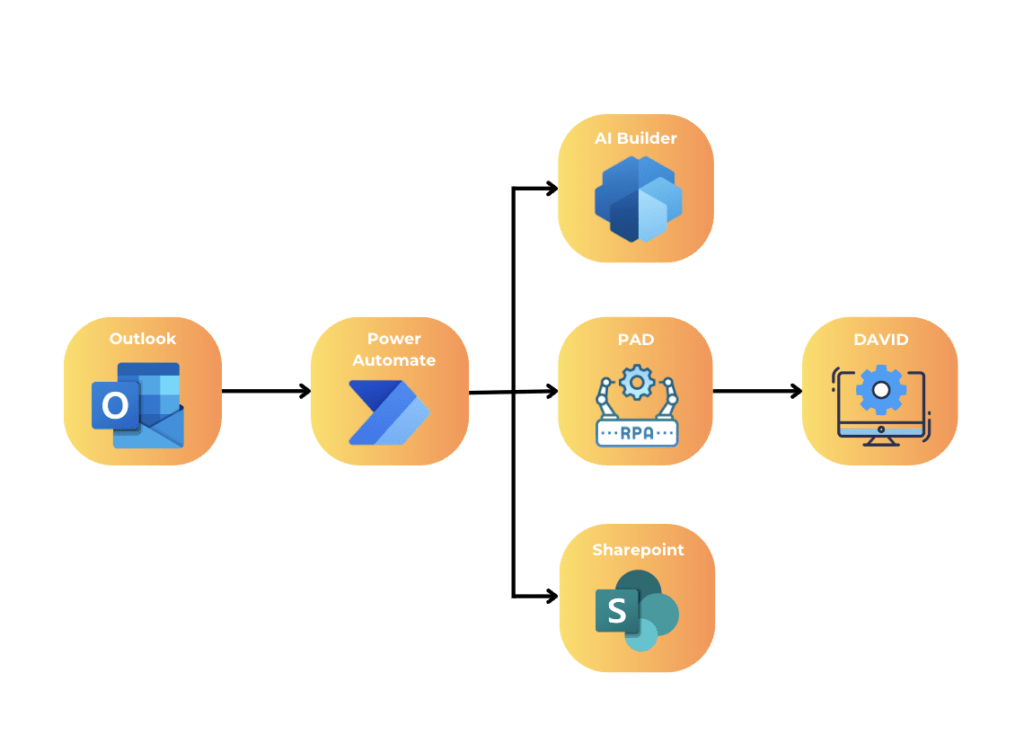
By implementing Microsoft Power Automate, we transformed these manual workflows into automated processes that reduce manual work and minimize the chance for human error. This automation project integrates tools like AI Builder, Robotic Process Automation (RPA) and Desktop flows to create an end-to-end automation solution.
Here’s how the new workflow operates:
Automatic Email Processing:
Emails arriving in a shared inbox are now automatically categorized by a AI builder document extraction model. The system recognizes different types of documents and sorts them accordingly. Each document is classified based on its type.
Automated Data Extraction and Entry:
After categorization, a AI model specific to each document type extracts essential data from the document. From there, the information is processed and allocated to the appropriate KOV team member. The next step involves a desktop flow using RPA to input this data into the David system automatically, eliminating the need for manual data entry and saving valuable time.
Organized Document Storage in SharePoint:
Power Automate’s child flows locate the correct SharePoint folder for each document, dynamically searching and creating subfolders if necessary. This automation ensures that each document is stored accurately, without relying on searching for the correct folders manually.
The impact
This automation project has transformed document and data management at KOV by reducing manual workload and improving data accuracy. This automated system also prepares KOV for future scalability and adaptability, allowing the organization to continue enhancing its operations as needs evolve.
- End-to-End and Fast Delivery: The solution was implemented efficiently, ensuring minimal disruption to ongoing operations.
- Significant Reduction of Hours: Automation significantly decreased the time spent on manual tasks, benefiting both employees and organizational efficiency.
- Post-Delivery Support: Sparkle’s ongoing collaboration and support ensured a smooth transition, empowering the KOV team to leverage the new tools effectively.
ABOUT THE AUTHORS
Lisell Aare & Pieter Jansen
Data Consultant
Discover more content from our blog

Connecting the Dots: Neo4j Graph Intelligence Inside Microsoft Fabric
Microsoft Fabric unifies data engineering, analytics, and AI across the Microsoft ecosystem.
But many business problems like fraud detection, customer 360, supply-chain optimization, … depend not on single data points, but on how those points connect.

Microsoft Fabric Ideation Session
The Microsoft Fabric Ideation Session helps organizations move from curiosity to clarity. In just three hours, our experts guide your team through Fabric’s AI and analytics capabilities to identify high-impact use cases, connect business goals with technology, and build a practical roadmap for value-driven transformation.

Exploring Microsoft Fabric: Workshop at Tallinn Data Week
Discover the power of Microsoft Fabric for unified analytics. Learn how to combine data integration, data science, real-time analytics, and business intelligence in a single platform.

From Data Chaos to AI-Readiness: Sparkle’s Adaptive Data Management Framework
Every company today wants to harness the power of AI. From copilots that accelerate daily work to generative models that reveal new opportunities, AI promises to transform how businesses operate. But there’s one constant truth: AI is only as good as the data it consumes.

Microsoft Fabric: From Reporting to AI-driven operations
Microsoft Fabric unifies data, analytics, and AI on a single platform, simplifying management and enabling real-time, AI-driven insights. Organizations can move from reporting to automated processes, unlocking efficiency, predictive insights, and smarter business decisions. Planning the transition now ensures a smooth, cost-effective adoption.

Power Bi Input Methods in Microsoft Fabric: Use Cases and Technical Solutions
Organizations using Microsoft Fabric with Power BI increasingly need ways to capture user input, not just analyze existing data. Until recently, the main native options were Power BI custom visuals and Power Apps. Since May 2025, a third option- Fabric Translytical Flows- has become available. This tutorial compares these three approaches to help you choose the right solution for your scenario.